Table of Contents
ToggleTiny house communities are transitioning from fringe concept to viable housing solution. As land costs climb and housing shortages intensify across U.S. metropolitan areas, developers and property owners are exploring planned micro-living neighborhoods that offer affordability without sacrificing quality of life. Unlike scattered ADUs or single tiny dwellings, these intentional communities combine compact housing with shared infrastructure, amenities, and social frameworks. Whether you’re a landowner evaluating a development opportunity or a builder considering your first cluster project, understanding the planning, regulatory, and design requirements is essential before breaking ground.
Key Takeaways
- Tiny house communities reduce per-unit development costs by 30–50% through shared utilities and infrastructure, making them a financially viable housing solution for developers targeting underserved markets.
- Zoning regulations, building codes, and local permits are the first critical hurdle—start with a zoning analysis and consult a land-use attorney before acquiring land to avoid costly delays.
- Strategic lot layout, genuinely functional shared amenities (workshops, laundry, storage), and outdoor living spaces of 100–120 square feet per unit are essential design features that drive resident satisfaction and resale appeal.
- Financing remains a significant challenge since most lenders impose minimum square footage requirements; portfolio lenders, chattel loans, and land-lease models offer viable alternatives for tiny house community projects.
- Infrastructure planning—water, sewer, electrical, roads, and stormwater management—requires detailed engineering and upfront cost estimates to ensure post-development feasibility and regulatory compliance.
What Is a Tiny House Community and Why Are They Growing?
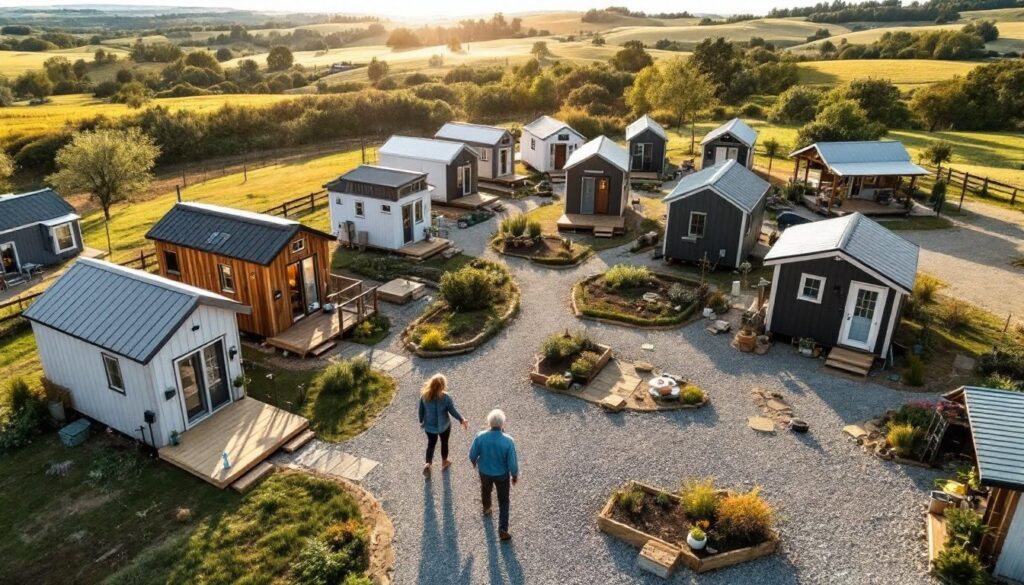
A tiny house community is a planned development of compact dwellings, typically 100 to 400 square feet each, situated on individual lots or clustered around shared infrastructure. These aren’t RV parks or temporary camps. They’re permanent residential neighborhoods with defined lot lines, utility hookups, and often communal spaces like gardens, workshops, or gathering areas.
Growth drivers are straightforward: housing affordability, aging demographics, and regulatory shifts. Median home prices in many markets have outpaced wage growth by 40% over the past decade, pushing first-time buyers and downsizing retirees toward alternatives. Meanwhile, zoning reforms in Oregon, California, and parts of the Southeast now explicitly permit “micro-dwelling” districts or accessory dwelling unit (ADU) clusters, reducing the legal friction that stalled earlier projects.
Construction cost per unit typically runs $50,000 to $90,000 depending on finish level and site prep, compared to $200,000+ for conventional single-family construction. That margin makes community-scale projects viable on smaller budgets, especially when infrastructure costs are shared across multiple units.
Key Benefits of Developing a Tiny House Community
Lower development costs per dwelling. Shared utilities, roads, and amenities cut per-unit infrastructure expenses by 30-50% compared to conventional subdivisions. A single well or community septic system can serve 10-20 units, whereas traditional platting requires individual hookups.
Faster permitting and construction timelines. Smaller footprints mean less site disturbance, reduced grading, and shorter build cycles. Many communities complete construction in 8-12 months from permit approval to occupancy, versus 18-24 months for standard residential subdivisions.
Appeal to underserved market segments. Retirees, remote workers, and income-constrained households represent demand that traditional housing stock doesn’t meet. Urban tiny homes in particular attract city-dwellers seeking ownership without suburban commutes.
Built-in community infrastructure. Shared workshops, laundry facilities, and gathering spaces become selling points rather than add-ons. These aren’t amenities, they’re functional solutions to limited individual square footage. Residents rely on communal tool sheds, guest cottages, and storage buildings that would be redundant in conventional neighborhoods.
Sustainability advantages. Smaller conditioned space means lower HVAC loads and reduced material consumption. Tiny home sustainability benefits extend beyond energy: water use drops, impervious surfaces shrink, and lot coverage stays minimal, reducing stormwater impacts and preserving green space.
Essential Planning Steps for Your Tiny House Development
Zoning Laws and Legal Considerations
Start with a zoning analysis before acquiring land. Most jurisdictions have minimum dwelling size requirements, often 500-1,000 square feet, that prohibit tiny houses outright. Look for:
- Planned Unit Development (PUD) zoning, which allows flexibility in lot size and dwelling dimensions in exchange for open space or design standards.
- R-3 or R-4 multi-family districts, where micro-units may qualify as apartments or attached dwellings.
- Recent ADU or micro-dwelling ordinances, especially in states with mandated zoning reforms.
Hire a land-use attorney or zoning consultant early. Variances are possible but slow: conditional use permits (CUPs) are more predictable if your project meets stated criteria. Expect 4-8 months for rezoning or CUP approval in most markets.
Building codes apply fully. Tiny houses on foundations must comply with the International Residential Code (IRC), including minimum ceiling heights (6’8″ for habitable rooms, 6’4″ for bathrooms), egress window requirements (5.7 sq ft minimum opening), and structural standards. THOW (tiny houses on wheels) avoid some IRC provisions but face their own challenges, most zoning codes classify them as RVs, restricting permanent occupancy.
Covenants, conditions, and restrictions (CC&Rs) govern community rules. Draft these before marketing units. Address parking, exterior modifications, pet policies, and guest limits. Overly restrictive CC&Rs deter buyers: too loose, and property values suffer from inconsistent maintenance.
Infrastructure and Utility Requirements
Water and sewer are your largest infrastructure costs. Options include:
- Municipal connections, if available: $3,000-$8,000 per tap fee plus line extension costs.
- Community well and septic, where permitted: $15,000-$40,000 for a well serving 10-20 units: $30,000-$70,000 for a shared septic system sized to projected daily flow (typically 50-75 gallons per person per day).
- Decentralized wastewater systems, such as aerobic treatment units or constructed wetlands, if your health department allows them. These reduce excavation but require maintenance contracts.
Electrical service requires a utility engineer’s load calculation. Tiny houses use less power (2-4 kW average demand), but your transformer and service panel must accommodate peak loads plus future expansion. Budget $8,000-$15,000 for transformer upgrades and main panel installation, plus $1,200-$2,500 per unit for meter pedestals and laterals.
Roads and grading. Private roads within the community must meet fire code access widths, typically 20 feet clear for two-way traffic, 12 feet minimum for one-way with turnouts every 400 feet. Use compacted gravel for cost control ($12-$18 per linear foot) or asphalt for durability ($25-$40 per linear foot, 18-foot width). According to resources from Fine Homebuilding, proper base preparation (6-8 inches of aggregate base) prevents settling and washouts.
Stormwater management is non-negotiable. Even low-impact developments must control runoff. Bioswales, rain gardens, and permeable paving reduce infrastructure costs while meeting detention requirements. Most jurisdictions require calculations showing post-development peak flow doesn’t exceed pre-development rates for 10-year and 25-year storm events.
Design Features That Make Tiny House Communities Successful
Lot layout matters more than individual home design. Arrange units to balance privacy with community interaction. Clustered parking with 8-12 foot walkways to front doors encourages casual contact without forcing it. Avoid long rows of identical units: stagger setbacks and rotate orientations to break monotony.
Shared facilities must be genuinely useful. A community workshop needs 120V and 240V outlets, a workbench with vice, and tool storage, not just an empty shed with a “workshop” sign. Laundry rooms require commercial-grade washers (3.5+ cubic feet) and high-efficiency dryers with proper 240V circuits and ventilation. Tiny home community residents depend on these spaces: underbuilt amenities create friction.
Universal design principles improve marketability. Even if you’re not building ADA tiny homes specifically, zero-step entries, 36-inch-wide doorways, and accessible bathrooms in at least 20% of units expand your buyer pool. Aging-in-place features, grab bar blocking in bathrooms, lever door handles, rocker light switches, cost pennies during construction and appeal to retirees.
Outdoor living space compensates for interior square footage. Each unit should have a defined patio or deck, at least 100-120 square feet, with electrical outlets and adequate drainage. Residents use these as seasonal extensions of living rooms and kitchens. Privacy screens (fencing, lattice, or plantings) are essential: 6-foot cedar or vinyl fencing runs $20-$35 per linear foot installed.
Storage solutions are critical. Many communities fail because residents accumulate belongings with no place to put them. Provide individual storage sheds (8×10 or 10×12 feet minimum) or a communal climate-controlled storage building with lockable bays. According to ImproveNet, the average household stores 200-300 cubic feet of seasonal and recreational items, tiny house dwellers still need that capacity.
Overcoming Common Challenges in Community Development
Financing conventional mortgages for tiny houses remains difficult. Most lenders require dwellings to meet minimum square footage (often 600-800 sq ft) and permanent foundation standards. Solutions include:
- Chattel loans for THOW, though rates run 1-3% higher than mortgages.
- Portfolio lenders or credit unions familiar with alternative housing.
- Land-lease models, where the developer retains land ownership and residents lease lots while owning structures. This sidesteps mortgage issues but limits buyer equity growth.
Neighbor opposition can derail projects before groundbreaking. Present your proposal to adjacent property owners early, emphasizing design standards, shared infrastructure investment, and market-rate pricing (not low-income housing, if that’s accurate). Renderings showing landscaping, architectural variety, and site screening help. Some developers pre-approve custom tiny homes designs to demonstrate quality control.
Utility capacity constraints surprise many developers. Rural water districts and small municipalities often lack excess capacity. Request will-serve letters from all utilities before signing purchase agreements. If capacity is marginal, negotiate phased development with utility upgrades tied to unit count milestones.
Resale value uncertainty worries buyers. Address this with comparables from existing communities, even if out-of-market. National data from Curbed shows established tiny house communities maintaining 85-95% of conventional home appreciation rates in similar locations, though the sample size remains small. Transparent HOA budgets, reserve studies, and professionally managed common areas build buyer confidence.
Weather and site-specific challenges require adaptation. In cold climates, frost-protected shallow foundations (FPSF) reduce excavation costs while meeting code. In flood-prone areas, pier-and-beam foundations with 18-24 inch clearance keep dwellings above base flood elevations. Wind loads in coastal or plains regions may require engineered tie-downs even for foundation-set units. Consult local structural engineers, don’t assume standard tiny house plans meet your jurisdiction’s conditions.